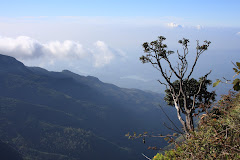
Hapuna Beach

Sunday, May 10, 2020

Hair in the Time of Pandemic


Yes, I saw those posts yesterday about some of you finally "getting your hair did" or else how you now can at last make that appointment to "get your hair did."

Not yet my situation.

I am on week ten or eleven since I last entered--in my own behalf--the premises of any establishment that provides services for one's hair. Gratefully, I no longer have roots requiring touch-up (a time sensitive and messy process) because I have totally returned to my roots and sport a hue created by my own body's melanin...or lack thereof. But the last time my hair was anywhere near this long, I was a true a brunette.

Several weeks back I called my sister Amy because I knew that at one point in her life she had cut her own hair, and I could see the encroaching possibility for such an endeavor becoming necessary in my own reality. She shared her technique and then some tips, as in, have the hubby check the rear view to be sure the back profile looks right and then even it out if not.

Well, that tip will not be happening with my current circumstances.

Sporadically I go walking with my neighbor Sharon.

[Yeah, I know, I know, we are not part of the same household. Seriously, though, we use the full width of the street--she with her dog on a leash and me properly socially distanced, and we switch our relative positions whenever Bentley (said dog) needs to explore odors emanating from the opposite verge. Okay, okay, neither of us wears a mask in the presence of just each other in the great outdoors, but we really have mastered the art of social distancing and neither of us engages in very "risky behavior," spending the bulk of our days at home. Besides, talking to someone in the flesh every few days is probably a good thing for me.]

Also like my sister, Sharon has hair-cutting skills and can take scissors to her own hair without catastrophic results. On our walk a few days ago, she commented on how long my hair has become, and when I complimented her on how chic her hair looked, she confessed she had trimmed it up the night before...with a little help from her grown-up son who lives with her. And again like my sister, she endorses the idea of having someone else tidy up the back once your self-styling effort has come to its best conclusion.

SIGH.

Meanwhile, I continue to forestall any cutting of my own hair, and my hair proceeds in its lengthening process:

Nowadays on mornings when I run, I pull my hair back into a ponytail. Short and stubby it may be, but here I am once again, decades later in my life, sporting a ponytail.

Last week I actually purchased some different hair doohickies for experimentation purposes, hoping to expand my repertoire of hair presentation. On the other hand, maybe I'll just surrender to the ease of production--as well as a cooler, less sweaty neck--and adopt the ponytail as my go-to style.

Monday, May 4, 2020

Cultural Humility

How many triangles do you see?


When in mid-March I began social distancing--a practice that has involved not seeing my kid clients face-to-face--my supervisor suggested that I catch up with my training hours by participating in some on-line training modules. Because I am a paraprofessional and not a licensed therapist, my yearly quota of trainings is mostly achieved by just attending monthly staff meetings and peer reviews. This past year, however, I missed several of those due to both personal travel and Master Gardener lab classes that conflicted with meeting times; I was legitimately excused by my supervisor for not attending, but I also did not accrue the training hours. (In addition, we ended up not holding staff meetings or peer reviews in March and April--social distancing protocols--but we do have a staff meeting scheduled for May via Zoom.) Hence, for the first time since my employment with Hale Kipa,  I explored the permitted-for-credit online trainings offered. Laudably, I have learned relevant concepts and practices that make a difference for me, and, happily, I have found these endeavors to be both engaging and motivating.

During a nine-module course entitled Early Childhood Mental Health, I first encountered the term "cultural humility" in the final lesson, one which presented strategies to incorporate into your actual practice with clients, like being cognizant of cultural considerations--your own and those of the children/families with whom you work. And not only to be cognizant of culture but also to understand how culture can impact/influence relationship-building, interactions, and even perceptions. That module concluded with an assignment for self-reflection focused on these questions: Who am I? How does my cultural background influence my values, beliefs, attitudes, and assumptions? What is blocking me from hearing, understanding, and learning from the person/family I work with? What is blocking me from fully caring about someone else?

About two weeks later, I took a course titled Implicit Bias: the Influence of the Unconscious Mind (from CDC Train website)and was immediately struck with how the idea of cultural humility dovetails with the concept of implicit bias and the influence of our unconscious minds.

In this course I learned that at any given moment, our unconscious mind is processing 11,000,000 bits of information; it then passes along 40 of those bits to our conscious mind in that same moment. Even still we make around 35,000 conscious decisions per day. Crunching the data, our unconscious mind analyzes 99.999996% of all the information our minds apprehend and also determines which bits--as in 40 of every 11,000,000--to pass along to the conscious. It is the gatekeeper of information: founded on its own accumulating collection of memories, social/behavioral experiences,  and, yes, biases, it sorts through the bits of perceived information, "finding patterns" and "filling in blanks," ultimately deciding what to delete or ignore, what to emphasize or de-emphasize, when to distort, and when to generalize.

Here are terms and explanations of common biases:

confirmation bias - interpreting new evidence as confirmation of one's existing expectations and beliefs (Think guns, gun control, and mass shootings and how the same evidence is used to confirm various perspectives of the controversy.)

halo/horn effect - a first impression colors or influences one's perception of a person throughout (Here use common perceptions of men and women:  the woman is bossy and the man is assertive; the woman is shrill/strident and the man is authoritative.)

beauty bias - physically attractive people possess other desirable traits (Consider that 60% of CEO's are over six feet tall although only 14.5% of the population is over six feet tall.)

affinity bias - preference/appreciation for people with whom we have something in common

conformity bias - a strong tendency to go along with the group (as in peer pressure)

So back to that lead-in question of how many triangles you can see in the diagram. There are no triangles in the diagram--only three V's and three Pac-Man-esque blots. But we see what we expect to see.

Our unconscious mind is susceptible to all of the biases listed above, and although it works out fine at times, what about all the times when it does not?

Our unconscious biases are also not necessarily related to our conscious beliefs and desires--hence, implicit bias. The Boston Symphony--predominantly comprised of males for a long time--made the conscious decision that it wanted to diversify and have more female members. For auditions they actively encouraged more women to try out. When they still ended up predominantly male in number, they moved to having blind auditions. Yet the number of males continued to dominate. It wasn't until they decided to have those participating in blind auditions remove their shoes before entering the audition area that the number of women accepted as members of the symphony substantially increased. The sound that high heels made as someone, presumably a woman, walked across the floor triggered a response in the unconscious minds of the judges.

So certainly there are strategies to combat the biases that lurk in our unconscious minds and break the connection between bias and behavior. First of all, we must become more aware of the potential for bias to exist in any situation. We have to be willing to doubt the extent of our own objectivity and increase our motivation to be fair. And maybe most importantly, we must improve the conditions for solid decision-making: "Think slow." It's true--those admonitions to breathe or count or do some other little thing to expand the time between impulse and action have real purpose and powerful impact.

And now let's return to the idea of cultural humility. A mental health professional--an African-American woman--described her experience of working with a client, a mother with a four-year-old son who was still drinking from a bottle. The mother wanted to know how she could best end her son's continued insistence on drinking from a bottle. The therapist confessed that at first she was dumbfounded with the inquiry and thought, you're the mother and he is four--just take away his option of having a bottle. Instead, though, the therapist decided to continue the conversation: What concerned the mother about making an end to this behavior? What were the hopes and goals she had for her interactions with her son? The therapist then learned that this mother wanted her son to know that he did not have to just submit to a power figure, that he could negotiate with regard to his own wants and desires even with people in power positions. The mother felt it was important that the son learn some negotiating skills. The therapist then recounted her own thought processes as she considered how to best serve this mother: The mother and son were caucasian, and within the culture in which this boy would grow up, there could actually be a safe space for him to negotiate with people in power positions. Although such a scenario was not necessarily true in the same way for the young boys in her own culture and was not consistent with her own upbringing, for this mother and son, the option could quite possibly exist. The son would lose access to a bottle but maybe gain the power to choose what socks to wear or what flavor of yogurt to consume for breakfast. There were choices this child could learn to negotiate for and remain safe in his environment.

Universal truths exist and are commonly shared throughout many cultures. Yet, other cultural practices and circumstances vary in all kinds of ways. We, however, continue to feel more comfortable inside the design of the culture that shaped us and often judge others and the world through the lenses that culture developed for us. Cultural humility, though, allows us to acknowledge that our comfort and those lenses are not really validation that our culture is better than another or that it provides a complete understanding of our world and the human condition at large. Humility indicates one is teachable, open to learning and knowing beyond one's current state. Cultural humility is critical to building effective relationships between client and therapist in the realm of mental health, but I think it carries vast potential for the world at large. Call me idealistic, but I like to think that if we would strive to practice more cultural humility in our interactions with human beings in general, we would be more open to accepting other peoples' stories and experiences as being as valid and as important as our own, and together we could build a better world.

Tuesday, April 21, 2020

My Bit of Ireland in the Tropics: Dry Stone Walls


My friend Tammy tells people that in Hawaii Evelyn is building Irish stone walls. Well, maybe I am. From the first time I witnessed them, Ireland's stone walls have captivated me, and, as I continue to construct stone walls on my own property, there have been multiple moments of conscious acknowledgement on my part that they may be a wee bit like the the ones in Ireland.

Before writing this post, I decided to Google "Irish stone walls," and here is what I learned about one of Ireland's distinctive landscape features: "It is estimated that the Irish countryside is a patchwork of over 250,000 miles of stone wall. Because the land in many parts of Ireland is naturally very stony, in order to be farmed, it had to be cleared of these stones. Since there was no easy method of getting rid of stones and there was a need to create separate divisions of the land, the obvious thing to do was to build walls."

In addition to a long held affinity for Irish stone walls (beginning with my very first visit in 1993), I relate to a couple points found within the Irish motivation to build stone walls. (1) My property is markedly "stony"; indeed, it is predominantly lava "bye-products" atop of even more lava. (2) There is no easy way to get rid of the stones...and I actually rather like my stones and have wanted to keep them.

During that cursory research of Irish stone walls, I also discovered the term that describes my type of walls--dry stone walls--the traits of dry stone walls, and their reason for being: "At their simplest these walls are easily built. Boulders are piled on top of each other, often with the largest ones at the base and the boulders getting smaller towards the top, though sometimes this is a subtle thing at best and the stones seem much the same size throughout."

Right now I will confess that my modus operandi fits 'this is a subtle thing at best.'

The description continues with these points:
  • These walls are built without any tools and with no mortar--the stone is not cut, though it may be broken--whatever stones are available are made to fit as well as possible. [TRUTH, although I do not break stones unless it happens without concerted effort by me.]
  • The walls are often quite low and not very stable; they constantly need to be repaired by replacing fallen stones, a task which farmers still undertake regularly. [Yep, not overly stable, and I do reparation sweeps of the yard periodically.]
  • However, paradoxically, it is their very instability that makes them good barriers, as livestock who are reared in the area are wary of trying to cross them, having learned from experience that they collapse rather easily, dropping heavy stones (painfully) on them. [Since my only livestock are feral chickens and stray cats, I have little experience with this virtue of dry stone walls.]
  • Some of the fields surrounded by these walls have no gates; the wall is simply disassembled to allow entry or exit and then rebuilt. [Although entry/exit is not one of my issues, I have disassembled and reassembled portions of my wall because I continue to uncover more rocks, and my wall-building skills have improved.]
When I first moved into my house, though, the only visible rocks in the yard were several large boulders placed for "landscaping purposes"(think "curb appeal") to aid in the selling of the place. All the rocks that comprise my stone walls still rested, well concealed, under a shallow layer of gravel--also spread across certain areas for "landscaping purposes"--or a rusty colored, coarse-grained dirt. When I attempted to plant a few bushes, I quickly encountered an entrenched population of rocks. Thus began my excavation of the property and the commencement of rock walls, two endeavors that continue to this day.

This photo--meant to document the catchment tank in my backyard--shows the way the backyard looked when I moved in. Can you see any black lava rocks anywhere? You cannot. At that time I did not have a clue about what really lay below the surface of things.


Now here, maybe around nine months in to this home-owning gig, the wall has begun. Actually there were some shelves of lava rock just below that rusty-red surface that were not broken and leveled to create the foundation space for the house. You can see them incorporated into the emerging rock wall on the left and in the back. 


And these photos show my backyard dry stone walls as of this month:


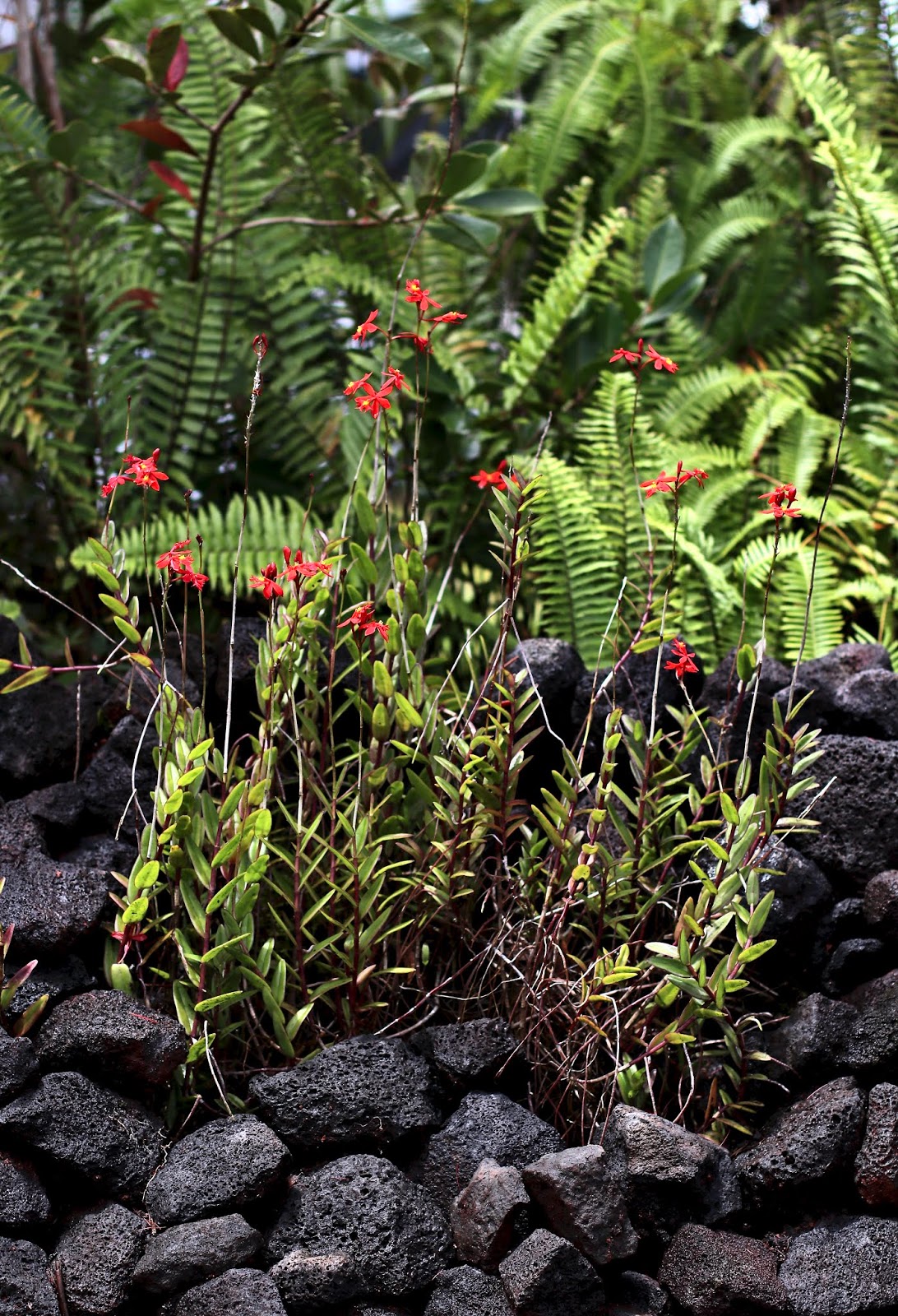
Dry stone walls with orchids and hibiscus.

Indeed, I have not neglected stone wall construction in my front yard either, but I shall unfold that landscaping story on another day in a different post...perhaps one titled "How Lava Rock Dictates Landscape Design."

And for my own purposes, I shall conclude with the final stanzas of a poem by Patrick Galvin titled "The Wall" because, in the end, stone walls for me will ever hold this enduring, mystical aura:


You could measure the light
By the wall.

And
if you stood close to the wall
You could hear the Earth moving
The stars burning
And the sun
Sinking
Slowly
Into a folding sea.

You could measure the dark
By the wall.

Tuesday, April 7, 2020

My Hawaiian Life, part 3

Lehua bloom on the ohia tree in my front yard.
Wild orchid, one of many that grow wild on the borderlands of my yard.
Torch ginger bloom, located in the vacant lot on one side of my yard.
Gardenia bloom from the bush in my front yard.

Last October while perusing a local newspaper, I stumbled across an article about the Master Gardener Program at the University of Hawaii, Hilo, with an email address for those interested in application information. Well, that described me.

 I knew when I bought my house and moved to Hawaii that I would spend time working outside in the yard. I just never anticipated how much time! I head outside to putter and/or labor for an hour or two, and then four hours have elapsed. I really enjoy that time, too--the exploration, the discovery, the creativity, and the therapy. Combine all that with my smidgen of previous knowledge regarding growing stuff, an even larger portion of growing/gardening things that I have kinda sorta heard mentioned or read about in passing, and a quantum of stuff I know nothing about--especially for the tropics--except that I was certain it existed, and my interest in a Master Gardener Program is manifest!

I wrote an email requesting the application for the 2020 program, completed it and sent it into digital space, and heard nothing until December. At that time I received notification that an interview would be required as part of the continuing application process. I complied and again heard nothing until the second week of January, a week before classes would commence. I had been accepted!

Master Gardener Programs (also know as Extension Master Gardener Programs) are volunteer programs that train individuals in the science and art of gardening. These individuals then pass on the information learned during training as volunteers who advise and educate the public on gardening and horticulture.  In the USA, Master Gardener Programs are affiliated with land-grant universities and their cooperative extension service offices. (The University of Hawaii has programs on Kauai, Oahu, Maui, and two in Hawaii--east and west sides.) Master Gardeners are active in all fifty US states and in eight Canadian provinces.

During that first class in January, I quickly realized that compared to my classmates I ranked low--maybe even the bottom--for previous gardening knowledge/experience and science/horticulture background, but hey, I had desire and motivation in my corner! I also learned that not everybody who applied was accepted, so there's that.

And since then, every Wednesday morning, we Master Gardener interns (the name badge we are requested to wear has "intern" plainly printed underneath our names) attend class for three hours where we are regaled by professors and specialists located in various places across the Hawaiian islands, all affiliated with the University of Hawaii and/or the Hawaii Department of Agriculture or the Hawaii Department of Land and Resource Management, and all flown in for their presentations for us in the flesh--until two weeks ago. Now we all attend via Zoom, and we students view our presenters in their "natural habitat."

Overall, the quality of both presenter and presentation has been top-notch. And who knew you could have a PhD in soil?! (Now that guy was the absolute best presenter; with him elucidating the traits, histories, and potentials of soils, the topic became riveting.)

On two Friday mornings, we had labs. For the one in January, we went into the forest and learned how to identify rapid ohia death. (Ohia trees are endemic to Hawaii and usually the first to grow on new lava flows.) In February, we had a propagation lab in the the Master Gardener greenhouse on campus and each of us created our own starts by seeds, leaf cuttings, and stem cuttings to take home. (UPDATE: Only three of my six stem cuttings are still among the living. Despite my poor showing with my original leaf cuttings, which all propagated absolutely nothing, I have started three new leaf cuttings on my own and so far so good. Who knows what happened to the seeds I started in the lab, but they didn't sprout. To my credit, I have grown cilantro from seeds in the meantime!) We were supposed to have a grafting lab the first Friday in April after our Wednesday lecture, but only the lecture--via Zoom, of course--has transpired at this point.

Every Wednesday since that very first class, I leave each session amazed once more at what new pieces were revealed to the panorama of knowledge I have of this place where I live. Here are some of my favorites:
  • Hawaii, the most isolated island chain on the planet, has only native species--endemic or indigenous-- that arrived by wind, wings, or waves; they were either champion swimmers, yacht racers, or balloonists. Hence, Hawaii has a relatively low diversity of native species but the highest rate of edemism, or native and found nowhere else. Hawaii flora is 91% endemic. Indigenous species are native but found other places. The sea turtle is the only native reptile. Forty-five percent of endangered US species are in Hawaii. 
  • Alien species arrived with human assistance, some good, some ultimately invasive. "Canoe plants" journeyed over with the native Hawaiians and included coconut, papaya, taro, bananas, and plumeria. Thirty-four flora and fauna were introduced to Hawaii by native Hawaiians. 
  • Sorry, but I, myself, am incapable of making the topic of soil riveting, but I now know that the soil I deal with in my yard is derived from lava (certainly no surprise), dominantly composed of coarse materials with minimal clay, is excessively well drained with low water retention and definitely acidic (due to high rainfall), and it has low nutrient supply capacity with only a fine fraction of it rich in organic matter. 
  • One must be aware of a plant's required light needs because Hawaii's hours of daylight, to include twilight, range from 11 hours and 16 minutes to 13 hours and 50 minutes. (By the way, Hawaii has standard time all year round, no switching...because what's the point?!) The closer one is to the equator, the more equal the amounts of light and dark become. There are seasonal plants thriving on the USA mainland partially because of the up to 16 hours of summertime daylight, so in Hawaii--like if one wants to grow corn--one needs to find a "short day" variety.
  • Although the grafting lab remains on hold, the lectures on pruning and grafting seriously resonated with me and not solely for their use in garden cultivation. As the lectures unfolded, the metaphorical connections of scriptural analogies to pruning and grafting re-emerged in my mind's eye with stunning clarity and emotional intensity. 
Classes conclude later this month, and although I hardly feel very masterful yet in my capacity as a gardener, I have learned to see and understand this land where I live with new vision, greater appreciation, and enhanced awe.


Monday, March 30, 2020

My Hawaiian Life, part 2

My house came into my possession somewhat equipped with basic appliances--stove/oven, refrigerator, and microwave--but I purchased a washer and dryer the first week I actually took up residence because laundromats are not places I prefer to frequent on a regular basis for weeks or months or years. In support of that preference, I have experienced a 4-year stint with laundromats once in my life (and I'm not even talking about the kind in the basement of a college dorm or apartment complex, something I've also done) Although there are some fun stories to accompany that four-year stint, I do consciously choose to have laundry facilities in my home whenever possible.

My dryer is electric--something worth noting here because electricity in Hawaii is expensive, and electric clothes dryers rank high on electricity consumption. Early on in my Hawaiian life, I noticed that many homes had clotheslines of various sorts and manufacture in the yard, in the carport, across the lanai, under the eaves. Last summer my "home improvements" included having a clothes line installed on the back lanai.


When I was a little girl, my mother did not have a dryer. I remember her hanging laundry to dry on a clothesline and that she had strategies and techniques to employ in that endeavor: one item of clothing shared a clothespin with the item next to it to conserve clothespins and line space, and underclothing hid in the interior of the clothesline configuration, concealed from perusal by neighbors and/or the public. Before my family had a dryer, if it arrived on the scene when we still lived in Colorado, I was nine or ten. I recall the clothesline in the backyard of the Colorado home and asking my mom why all the undies hung in a certain section--hence, that explanation! If the first dryer actually happened when we lived in New Jersey, well, then I was eleven. But after the first dryer, we always had both a washer and a dryer in our home. One time when I was in high school and we lived in Utah, I remember folding clothes with my mom and she told me how much easier laundry was with a dryer and that things like towels felt nicer when dried in a dryer than when line-dried, but not bed sheets; line-dried sheets were the best.

I have had clothespins in my possession at least since I was married, and I've carried them with me to maybe ten different places of residence across four countries and three continents, but I have never had a clothesline. Until now. Granted, I have purchased a few more clothespins to add to my collection now that I hang clothes on a line in real life on a regular basis. But until my Hawaiian life, I don't believe I ever envisioned myself routinely doing laundry using a clothesline.

My dryer is still employed, just not as often. Towels, for instance, are truly better when dried in a dryer--softer and fluffier. And occasionally a speedy dry-time becomes essential for some scenario or another. My mom was right, though. Line-dried sheets are the best; they have a certain crispness to them that no dryer can achieve.


I suspect my mom found doing laundry that entailed the use of a clothesline for drying purposes for a family that included multiple children quite labor intensive. Also, when there was a baby, she used cloth diapers as well! I, on the other hand--and there is just me--quite enjoy the hanging out and bringing in of clothes that dry on a line. I like breathing in the scent of freshly washed laundry, designing the line-up for each row, being enveloped in between two parallel planes of strung-up laundry, and reopening memories tucked away from long ago.


NOTE: Depending on the month, my electricity bill is $10-$15 cheaper than it was before I had a clothesline.

Friday, March 20, 2020

My Hawaiian Life, part 1


Two and a half years in, I live pretty much ensconced in a Hawaiian life, and it is good. But a lot has happened since the lava eruption of 2018, and I have decided what better opportunity to attempt to create some record of it than while in social distancing mode during a pandemic.

Although retired from a forty-year career as a teacher, I have a part-time job in a different career field these days--working as a paraprofessional with at-risk youth under the direction of licensed mental health therapists. Granted, my actual working labors are on hold at the moment as I engage in more stringent social distancing. Still, in more normal times I spend one-on-one time with my assigned kids, usually out somewhere in the community or driving around in my car. We talk and we do stuff and we talk. Except when one of your kids is a four-year-old. Instantly, the DOING totally dominates.

Until last fall, all of my kids have been teens or pre-teens except for a brief stint with a seven-year-old. And then this therapist approached me with the chance to work with the four-year-old, and the four-year-old was still three!

First of all, after serious toil, sweat, and almost tears (until YouTube and my car owner's manual saved the day), this happened--
something I had come to believe I would be omitting from my life experiences.

And then, this happened:
There was a three-year-old in my life for two hours twice a week!

Now he's four, and I have become well acquainted with the playgrounds of at least eight parks situated from Hilo to Mt. View to Pahoa--in addition to their restroom facilities, as adequate or inadequate they may be. I swing on swings again...when I'm not pushing said four-year-old on his swing so he can "fly." Occasionally, I even slide down the slide at his behest.

I now accept full blame for introducing another human being to the pleasurable hilarity of popping bubble wrap with fingers and/or by walking or jumping on it. I have returned to a zoo--a place with which I have a conflicted relationship since having had opportunities to view so many of those same animals in their natural habitat--because a kid with an intense playground obsession will forsake it all (cool zoo playground included) to lead me to each to new animal, to illuminate with steady chatter the details of teeth or eyes or color or sound, showing me again how to see with new vision the splendor and wonder of the world. I have learned to look for sharks at grates over street drains, although I still refrain from feeding them grass and I only listen to the four-year-old regale us all with the "Baby Shark" song. I construct castles again with building blocks, glory in building a tower, and screech-laugh at the destruction of a collapse. I have discerned that for a four-year-old, one with impulse control issues who is rarely allowed into the interior of many commercial establishments, a store can be a fantasy realm where even the discovery of shoes or red juice or blue juice or bread or a ball is a magical thing.

And I am humbled at his generosity and unexpected concern for me: I bring him snacks, and he is ever willing to share. One time I gave him a small package of Oreos, which he opened (with a little help from me, but he was in charge!) and then gave me one cookie for every one he ate himself. When he has multi-colored Gold Fish for a snack, we now play a game where we identify how many and what color(s) I receive. With colors, he is spot-on; with numbers greater than three, not so much. Numbers beyond three generally acquire the label "lots." And then there's the umbrella, something you may have already surmised holds great fascination for him. I carry two in my car because, you know, I live in a rainy land. When he enters my car, he inquires about HIS umbrella. He always wants to take it with him to the playground or wherever we may disembark. but I insist that it has to be raining. One time at the zoo, the day was misty, moisty, and I let him bring HIS umbrella, but I did not carry the second one. Eventually, when it began to rain with more intent, he wanted to protect me, too, with his umbrella. Of course, he also wanted to hold the umbrella, so you can imagine how well that worked. Still, I crouch-walked with him under that umbrella for several stretches, and I bet we looked cute!

Little kids, though, are not inhibited by social norms. Boogers and bathroom exploits, particularly the preponderance of toiletting explanations regarding "shi-shi" and "doodoo," can give one pause, especially when one holds said kid's hand quite frequently. Nevertheless, I am missing my four-year-old this week. Living life with the joie de vivre of a four-year-old is surely a worthy aspiration.

Monday, August 6, 2018

Volcano in Suburbia


Ever since childhood, where I witnessed more than once that ubiquitous grade-school mock-up of a volcano that explodes with a mix of baking soda and vinegar and read with riveted focus multiple apocalyptic accounts of Pompeii’s destruction, volcanoes have piqued my curiosity, appealed to my sense of wonder, and frightened me utterly. Yet now I live on an island created by volcanoes and still operating in volcanic creation mode. In fact, the volcanic vent sponsoring the current eruption of Kilauea lava is located maybe ten miles or so from my house. 

Here I am, the one suppressing constant willies during any visit with friends or family to Volcanoes National Park although I remain fascinated with all the science, history, and lore presented and observed while there. [At present the park is closed—since mid-May actually—and when it reopens, many of the landmarks and details recorded in my memory from previous visits will be radically changed or gone altogether.] Here I am, the one who cherishes every mile of distance between my abode and the park: maybe 20-25 of them “as the crow flies.” And here I am, the one who felt absolutely no disappointment when my realtor informed me that my mortgage company would not finance a home in lava zones 1 or 2.

Nevertheless, rather early Monday morning, April 30, I received a phone call from a church member notifying me that some people might be required to evacuate because Kilauea had shifted into imminent eruption mode and suggested that I review my “evacuation kit.” (A committee of church members had been assigned to contact as many church members as possible that morning.) At this point, volcano precautionary measures had not yet arrived at news-worthy status for radio and TV; that happened on Tuesday.

On Tuesday, May 2, the lava lake in the crater of Kilauea began to drop, and driving home from Hilo on Wednesday, May 3, I saw this plume rising on the horizon. 

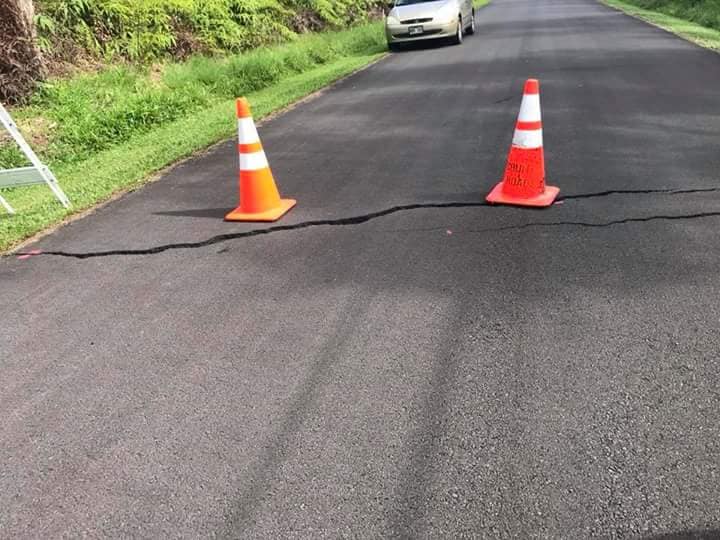
Cracks appeared on residential streets and properties of the lower Puna District, and by May 3 some of those had grown into fissures that would leak and or spew lava.

Thursday morning, May 4, while working in my yard—and sitting on a section of very volcanic rock—I heard and felt a significant earthquake:  one that ranked as a 5.4, I learned later. But that was only a prelude for what awaited us. Just after noon, a much larger earthquake struck:  6.9 this time. Having spent seven years living in Japan, I became quite familiar with the rattle and shakes of earthquakes, some of them providing quite a jolt or pitch and sway. This one here in Hawaii Island on May 4 takes the top spot for all of it: strength, length, rattle, shake, skew, and breakage. I actually left the house before it finished. All pictures on the wall required straightening, and three pictures resting on shelves and against the wall fell over, breaking the glass on one when it took a second spill to the floor. Outside I have a 10,000 gallon catchment tank, and—remember, I had escaped my house before the earthquake finally ended—I suddenly realized it had begun making this sporadic, but rather rhythmic, sloshing sound. With closer examination, I saw water spill over the top on one side, followed by the sound of rolling water before then spilling over the opposite side, and repeat again. The pattern reminded me of my bathwater when I was a kid and sliding from one end of the tub to the other “to make waves.” 

For the first ten days or so after opening, the fissures emitted noise that I could hear from my house. At night I would lie in bed listening to what sounded like distant thunder but from a storm stalled; it never advanced or retreated. The first night of that eerie fissure noise, I didn’t sleep well, creating all manner of images of advancing lava. I even reworked and augmented my collection of evacuation stuff the next day because the sounds unsettled me so. But then I grew accustomed to the dissonant music and didn't even notice exactly when it went silent.

An erupting volcano in the neighborhood prompts all kinds of new behaviors in addition to that first action of formulating evacuation plans: What about ash? What about bad air? What about acid rain? What about lava…well okay, for lava danger—because lava wins any sort of confrontation—you evacuate…always…and that is something a shield volcano (all volcanoes on-island are shield volcanoes) generally allows time for if one is paying any sort of attention to it. But those other possibilities that arise with an erupting volcano? I read and I listened and I attempted several different precautionary measures, some more successfully than others. A friend told me that water in catchment systems on this island with an active volcano is always a bit on the acidic side, something that can be mitigated to a certain extent by adding baking soda to it. My reading confirmed that statement, and following some amount guidelines I learned from my reading, I dumped into my catchment tank the contents of the two boxes of baking soda on hand, figuring I would buy more on my next foray into town for groceries and other supplies. I quickly discovered, though, that in Hilo and environs there was no baking soda available for purchase; the shelf space for baking soda—in food or cleaning aisles of multiple establishments—remained empty for at least the next two weeks. The other item that sold out quickly during this time was tarps big enough to cover a catchment tank—employed to prevent ash contamination of household water should an ash event occur. I shall not enumerate here my trials and travails with tarps, to include the placement of tarps over my catchment tank…considering my lack of height and my dogged desire not to be dependent if at all possible…and there was more than one placement attempt in this saga because I had enormous difficulty acquiring appropriately sized tarps and dabbled in various jerry-rigging ventures. It was not pretty! I ultimately abandoned the tarp experiment several weeks later because, due to the amount of rain we receive on the windward side of the island, a tarp over the tank became more of a liability than benefit. Due to the inordinate weight of puddled rainwater, removing the tarp proved to be an ugly endeavor as well—personal height and independent streak withstanding!

Fissure noise surrendered to expansive quantities of lava spewed furiously and continuously from mostly fissure number eight, and the lava glow lit a portion of the night sky in crimson and vermillion—a stunning spectacle for its mesmerizing beauty combined with its daunting creation story.
 Pahoa Town by day.
Pahoa Town by night with the lava glow.
Lava glow from my street.

Fissure eight, just like over twenty other fissures in Kilauea’s rift zone, opened up on a level expanse of suburbia in early May. Soon it became Kilauea’s preferred lava exit point in this eruption. As the lava continued to spew, it created a cone that rose over 180 feet tall and sourced a snaking lava river that eventually found the ocean over eight miles away. Almost ten square miles of lower Puna is covered by this lava flow now, to include over 700 homes, agricultural land, lush rain forest, and shoreline tide pools. The lava flow has also added at least a mile of new land to the island.

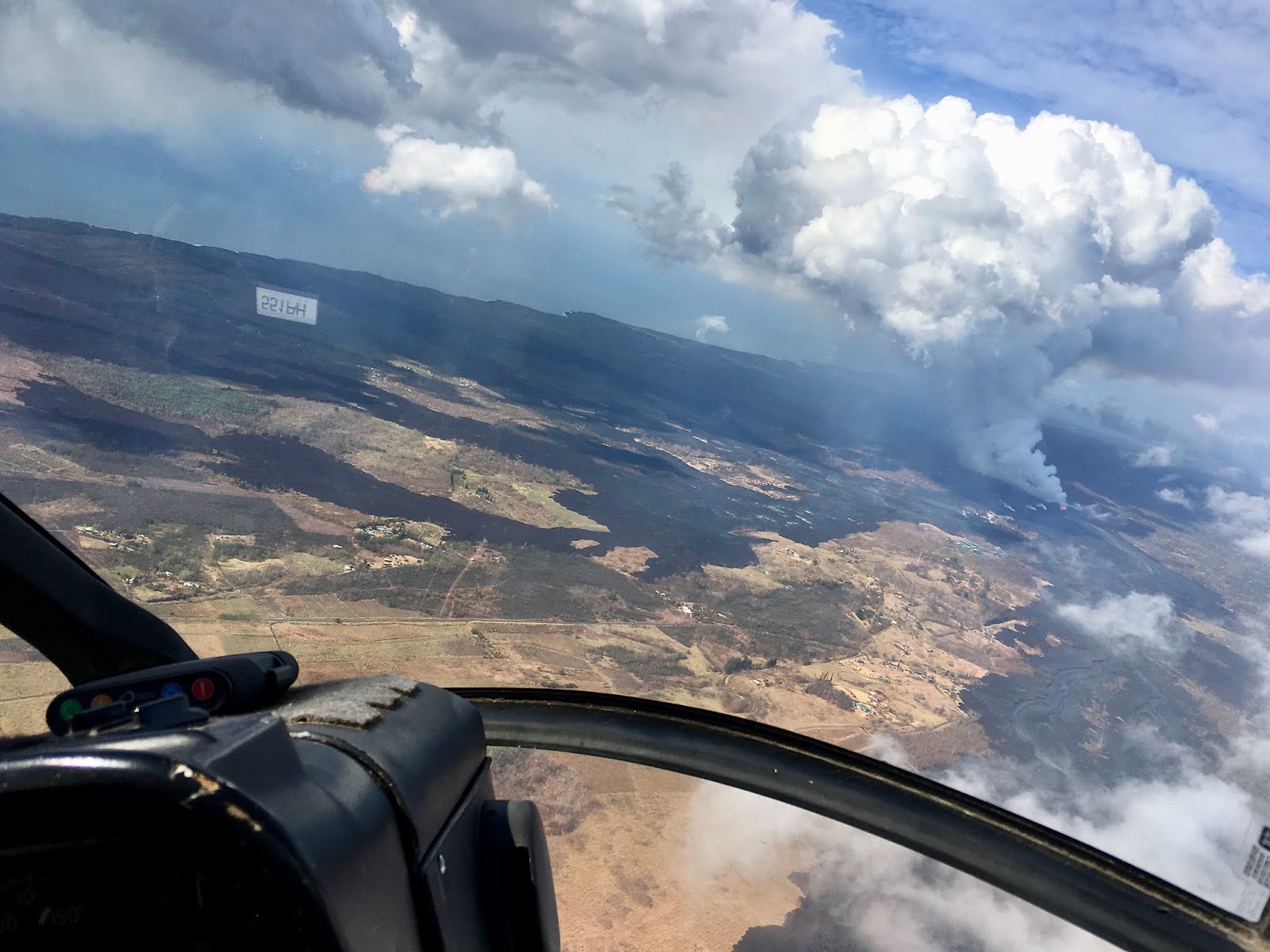
The first week of July with my friend Camille I had the chance to take a helicopter tour of the eruption area. It was an amazing experience—beautiful but also awesomely humbling. These are photos taken during that tour:

As of Tuesday, July 31, the current Kilauea eruption has lasted longer than any previously recorded ones. Today, though, Fissure 8 has noticeably stilled its lava production. Has Kilauea completed her endeavor or is she taking a small break? No one yet knows.
Fissure 8, Sunday, August 5, 2018


APPENDIX: Volcano Vocabulary

Over these last weeks I’ve also increased my knowledge of the language of volcanoes. Before this eruption I had mastered the difference between pahoehoe lava and a’a lava: Pahoehoe lava has a smooth or “ropy” surface while a’a consists of free chunks of very angular pieces of lava. Pahoehoe lava designs contour line designs as it cools and a’a looks totally like something you would cross barefoot absolutely howling “ah-ah, ah-ah!” 

Now, though, my vocabulary has expanded. Clinkering describes the sound “clinker” lava—a type of a’a lava, often brittle and breakable—produces when it shatters. Pele’s hair refers to the fine threads of volcanic glass formed when a spray of lava droplets cools rapidly in the air. Abrasive, it can cause irritation to skin and eyes. It can also cut you. Pele’s tears, jet black and often found on one end of a strand of Pele’s hair, are small pieces of solidified lava formed when airborne particles  fuse into tearlike drops of volcanic glass. And then there is the lava bomb—a mass of molten rock larger than 2.5 inches in diameter, formed when ejected viscous fragments of lava cool into solid fragments before they reach the ground. I would be remiss not to include these atmospheric terms, too: Vog is volcanic smog—sulfur dioxide as well as other gases and particles emitted into the atmosphere by an erupting volcano. Laze, formed when lava enters the ocean and triggers a series of chemical reactions, is the steam cloud that rises above the entry area. Comprised of hydrochloric acid, other gases, and volcanic glass particles, it is hazardous.