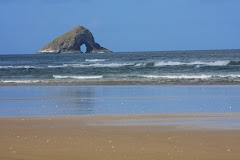
Hapuna Beach

Saturday, February 1, 2014

Where the Desert Meets the Sea


During a week of days ending 2013 and beginning 2014, I sojourned in a land where the desert meets the sea:  Baja California Sur, Mexico. As one who is continually awed by the unexpected beauty of desert but who ultimately prefers terrain lushly green with prolific vegetation, I suspect I could reside in Baja's stunning rendition of a desert clime--at least its southern tip--more easily than others I have known.  

Truly Baja Sur presents iself as quite pretty desert:  tall, peaky mountains in its center, deeply-hued rock and stone to fashion cliffs and bluffs, appealing vegetation, . . .


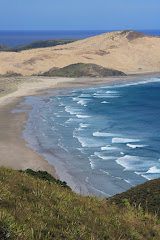
and always in proximity to the sea, one painted in tropical blues and often caressing expansive sandy beaches--pale gold to platinum.


My friend Carolee and I flew into La Paz via Los Angeles and took up residence for the week in a hotel there in La Paz on the Malecon--the Spanish word for a stone embankment or esplanade along a waterfront. In the mornings we would walk/run along the Malecon with boats and sea as a backdrop and in the company of fellow walkers/runners, applicable statuary, a few fishermen, and plenty of pelicans.


Thanks to a rental car, we had the chance to spend the rest of each of our days exploring not only La Paz and its environs but also the loop of highway circling south and west from La Paz to Todos Santos, situated on the Pacific coast, and on down to Cabo at the southern tip. From Cabo, we turned northwards toward La Paz but this time on the eastern coast highway running along the Sea of Cortez.

There are two Cabos at the southern tip of Baja:  Cabo San Lucas and San Jose del Cabo. Both have gorgeous settings, and the 30-kilometer "corridor" between them is absolutely dazzling. Cabo San Lucas throbs with a party-city vibe, and the McDonald's where we stopped in the early afternoon for its restroom facilities and some refreshment was thronged with English-speakers, mainly with American accents, and it had already sold out its supply of ice cream and Sprite.
Beach moment--Cabo San Lucas.

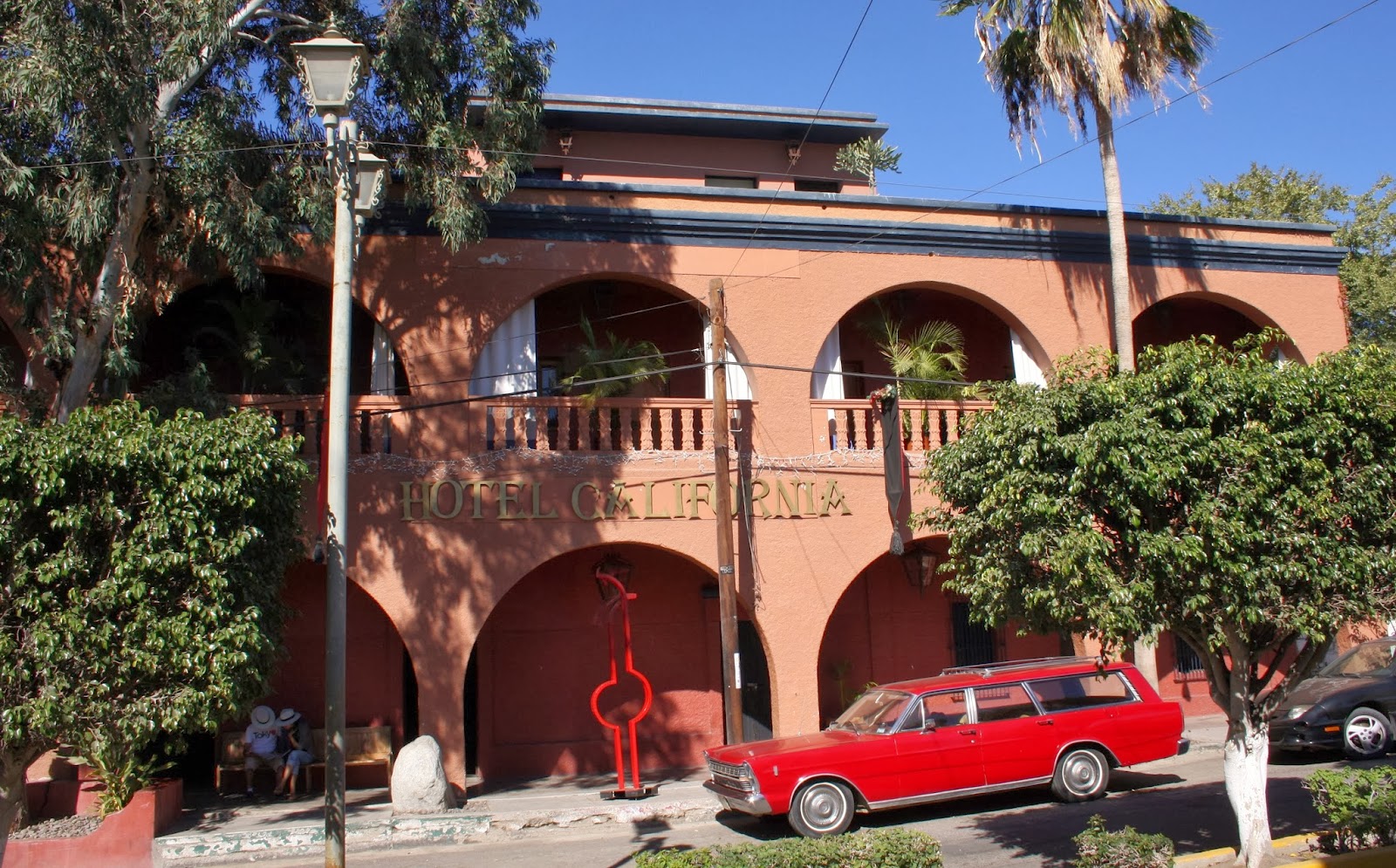
Todos Santos, the town where Carolee and I decided we would like to stay should we ever return to Baja Sur, has a Hotel California, rumored to be the inspiration for the famed Eagles' song "Hotel California." Apparently this seemed a possibility because the Pacific coast of Baja near Todos Santos became popular with surfers in the 1960s and the Cabo San Lucas area was certainly popular with rock stars of the 1970s. Alas, I have discovered since my return home that it is an urban legend.  The song is not about a hotel at all; instead, it is a metaphor for the loss of innocence, particularly for artists who find themselves "ensnared in the 'glittering web' of life in the music industry."  In an interview with 60 Minutes in 2007, composer Don Henley described the song "Hotel California" as a "song about . . . excess in America, which is something we knew a lot about." He alluded to the fact that in a culture of decadence and wealth, it is easy to be trapped in the high life, dealing with the dark underbelly of the music industry. 

Still, once one has driven that loop of highway and wandered the cobbled walkways of Todos Santos and other coastal villages, those lyrics evoke the experience and conjure memories of scents and sounds and scenes, witnessed or imagined.


Hotel California
On a dark desert highway, cool wind in my hair
Warm smell of colitas, rising up through the air
Up ahead in the distance, I saw a shimmering light
My head grew heavy and my sight grew dim
I had to stop for the night
There she stood in the doorway;
I heard the mission bell
And I was thinking to myself,
"This could be Heaven or this could be Hell"
Then she lit up a candle and she showed me the way
There were voices down the corridor,
I thought I heard them say...

Welcome to the Hotel California
Such a lovely place (Such a lovely place)
Such a lovely face
Plenty of room at the Hotel California
Any time of year (Any time of year)
You can find it here

Her mind is Tiffany-twisted, she got the Mercedes bends
She got a lot of pretty, pretty boys she calls friends
How they dance in the courtyard, sweet summer sweat.
Some dance to remember, some dance to forget

So I called up the Captain,
"Please bring me my wine"
He said, "We haven't had that spirit here since nineteen sixty nine"
And still those voices are calling from far away,
Wake you up in the middle of the night
Just to hear them say...

Welcome to the Hotel California
Such a lovely place (Such a lovely place)
Such a lovely face
They livin' it up at the Hotel California
What a nice surprise (what a nice surprise)
Bring your alibis

Mirrors on the ceiling,
The pink champagne on ice
And she said "We are all just prisoners here, of our own device"
And in the master's chambers,
They gathered for the feast
They stab it with their steely knives,
But they just can't kill the beast

Last thing I remember, I was
Running for the door
I had to find the passage back
To the place I was before
"Relax, " said the night man,
"We are programmed to receive.
You can check-out any time you like,
But you can never leave! "

Wednesday, December 25, 2013

Moments for Rejoicing

As concluded in an earlier post, the joys in my life do outnumber the moans and groans; hence, as a counterpoint to my previous moanings and groanings I shall now recount some of my celebration moments of the fall:

1.    The antibiotics worked!  I have felt so much better in the last ten days than I have felt in at least six weeks.  Add to this glorious condition of general health the fact that mucous no longer secretes unexpectedly and perniciously from sundry facial orifices on random days and you may more fully appreciate my jubilation.

2.    One morning in early December, I decided to brave the cold and walk to work.  Certainly an auspicious influence for my rationale did include the realization that the temperature had risen several degrees to achieve a position closer to "freezing".  Upon entering the street that morning, even noting a smattering of flakes moseying in a generally downward direction did not deter me.  About a block away, I thought saw a flash, and to confirm my thought, a few moments later I heard the distinct rumble of thunder.  Soon my walking commute became enveloped in a thunder and lightning snow storm.  After a particularly clamorous clap of thunder, the snowflakes pushed themselves as close to a pelting velocity as flake structures can muster.  Having retrieved my umbrella from my backpack, I was actually feeling rather giggly--such joyful wonder at this unexpected juncture of events.  At the traffic light I met up with a soldier decked out in winter PT gear who was whooping and hollering in glorious disbelief.  He escorted me to the gate in gleeful good cheer, and this walk to school has since become one of my most favorites during my time in Seoul. 

3.    I really enjoy my students this year.  They are lively, fun, and generally self-motivated to learn.  They make me laugh.

4.    I like teaching English Language Arts.  With all these years of teaching collecting behind me now, I realize more fully that English Language Arts really is my favorite subject to teach.  I am in the right place.

5.    My colleagues in the English Language Arts Department this year are all good teachers dedicated to both students and their subject—not always a given any more these days.  Our conversations teach me and entertain me.

6.    Being under the weather, so to speak, for goodly chunks of time this fall has reintroduced me to the enormity of what I can watch via the television screen, Netflix, and my own private collection.  For the first time in Korea, I watched two of my best-loved movies—My Brilliant Career and Out of Africa—in close succession and wandered through the first two seasons of Downton Abbey.  Each fully transported me into its world.

7.    Over the Thanksgiving break, I journeyed to southwestern Korea to the city of Gyeongju, where the ancient Silla Kingdom placed its capital.  In the Korean Culture and Language Course I took my first autumn in Korea, the professor claimed that this city was the one we most needed to visit during our time in Korea.  I finally made it, and the experience created some distinct visual memories.

Tumuli--burial mounds.


Bulguksa Temple, first constructed in the sixth century.


Truly I am very blessed.

Saturday, December 14, 2013

Some Moaning and Groaning

Although overall life remains good—even very good—perchance this fall will rank as my roughest one in Seoul.  Hence, I shall now whine:

1.   It’s COLD!  And way earlier than in my previous three years in residence in Seoul.  In fact, snow has fallen on multiple days this past week.  Despite not being particularly measurable, temperatures preclude the possibility of precipitation arrayed in anything besides white.  And the dreaded truth of wintertime in Seoul contains the reality that once the temperatures plunge, they prevail, pretty much entrenched within the weather patterns until late in February.  Seoul just does not participate in any kind of thaw once the first serious cold arrives until the planet finally revolves its way through the winter season.

2.   Seoul American Middle School will receive its accreditation visit in February of this year.  Such visits tend to generate a flurry of time-sucking activities to showcase all the wonders the visited school has established within its auspices so that a visiting team can see in two and half days what teachers do in an entire school year and what a school, as a whole, develops over a period of years.  Add to that the fact that this fall Seoul American Middle School received national recognition for being a Blue Ribbon School, and perhaps you can imagine the elevated frenzy and stress accompanying the original “dog and pony show” endeavors so that this visiting team is also cognizant of why such a status was warranted.  I am very weary of all the stuff to do that really has little impact on improving teaching and learning in a classroom.

3.   One weekend early in October, a germ established what has become a long-term habitation inside me.  Blasting headaches, congestion, aching teeth, conjunctivitis, a string of canker sores along the left side of my tongue, mucus—all have presented themselves at least once this fall.  Did I mention mucus?!  Yeah, well, my body has produced unthinkable quantities of it in the last eight weeks, and I think it may have oozed through pretty much every facial orifice at some point.  So, the germ vs. me routine unfolded this way:  I would rest up for a couple of days, and the symptoms would abate.  As soon as I added any physical activity—I forsook any thought of running sometime in the middle of November—or otherwise exerted myself, though, symptoms reappeared.  Last week when I awoke with my right eye stuck shut, seeming to threaten a SECOND bout of conjunctivitis, I sought medical attention, the first time I have ever had to do this in Seoul.  Forthwith I made an appointment with an international clinic recommended to me by my friend Pam, and Dr. Kim—a physician trained in the USA who set up a practice in Seoul geared for expats and foreign workers—diagnosed me with a bacterial sinus infection.  He prescribed a ten-day course of antibiotics and a decongestant. 

4.   My digestive system seems to balk when antibiotics enter its domain.  My last course of serious antibiotics occurred after my surgery for appendicitis over five years ago, and I fully recall the digestive tract shudder.  I have been on antibiotics for two days now and the rumblings abdominal are truly phenomenal!

5.   May car emits a funny sound when I turn sharply to the right.  SIGH.

6.   And alas, I remind you that it’s COLD here!  Way too cold for the likes of me.  More and more I am convinced that I may actually be a tropical girl merely in the guise of one with northern European ancestry.

Meanwhile, having purged myself of the perversity in my life—and I certainly realize how inconsequential it all is in the scheme of things—let me confess that the list of joys in my life this autumn outnumbers my moans and groans.  Stay tuned.


Sunday, November 10, 2013

My Favorite Smoothie Looks Like Sludge

In October I began working with three other women to support and instruct those leading the women’s auxiliary at church in the various English-speaking congregations in Korea.  Except for the one in Seoul, those congregations are all connected to U.S. military posts and bases and tend to be rather small.  Seoul, though—despite its mega-metropolis status—has only one English-speaking congregation, and it is huge.  The children’s auxiliary has over a hundred children attending.  Although the majority of the members are American—affiliated with the military, embassy, business/industry, universities, or the network of English teachers—over twenty nations are represented in that congregation. While in Korea, if one does not attend Korean-speaking services, an English-speaking one is the only other option.

Because we wanted to meet the women leaders in each congregation and better understand the dynamics and any needs, the four of us have been traveling on certain Sundays to attend services with congregations outside of Seoul.  (The four of us all live in Seoul.)  Kim actually likes to drive (even in Seoul!) and her vehicle has a most capable GPS system, so we pile into her van and hit the highways and byways of Korea.  Our first foray took us to Daegu, where the most distant of the congregations we oversee is located.  We left early one Sunday morning in the pinky glow of dawn.  Although the GPS indicated the trip would take four hours, we arrived in three.  The return trip took SIX…thanks to the traffic heading back into Seoul on a Sunday afternoon.  Consequently, we have already had the opportunity for lots and lots of chatting and have certainly begun collecting the associated collateral learning.

For instance, we all like to read, so we talk books.  Kim and Michelle are in a book club together where recently they discussed Unbroken.  Now I will be reading Unbroken.  Both of them expressed interest in books with a Korea connection, so I mentioned two I have read that made an impression:  Adam Johnson’s The Orphan Master’s Son and Kyung-Sook Shin’s Please Look After Mom.

Kim and Michelle also run, and—unlike me—Kim, Michelle, and Chu cook.  But I am interested in food and nutrition, so when Kim shared her recipe for her favorite breakfast smoothie, I took mental notes, actually even purchased the mini-blender with single-serving containers at the PX, and then tried my own variation of it.  It is now my all-time favorite smoothie. 

And with that statement, perhaps the title of this post suddenly begins to exhibit some semblance of a correlation to all that has spilled forth so far.

So, here is my recipe:

  • ¾ cup of almond milk  (I use the unsweetened.)
  • 1 small frozen banana
  • 1 tablespoon of peanut butter
  • 1 tablespoon of cocoa
  • 1 hand-full of spinach
  • ice as desired  (I have found that if both the banana and spinach are frozen, the drink is plenty icy)
  • honey as desired  (I do not need any additional sweetner—the banana is enough—but I am not a particularly “sweet” person.  I like my chocolate dark, dark, DARK.)

And this smoothie is dark, very DARK.  It looks like swamp mud, the absolute essence of sludge! 

Yet it tastes so incredibly good!  I will come home from school craving it.

Kim actually uses chocolate protein powder, but I have never used protein powder, purchased protein powder, and have yet to do either.  However, my smoothie recipe does not work for me as a breakfast all by itself (I get hungry too soon), and that might be because I don’t use protein powder, just a tablespoon of Hershey’s Dark Cocoa powder.

 My version works exceedingly well as dessert!


Friday, October 25, 2013

And in October . . .

Maybe because so much of my life in Korea unfurls in Seoul, I have amassed an extensive collection of experiences and memories structured around big-city living; remember, Seoul does rank as one of the planet’s largest cities.  For Columbus Day weekend, though, my friend Pam and I totally abandoned Seoul and its environs, traveling in a northeasterly direction to the coastal city of Sokcho and the nearby Seoraksan National Park.  This encounter with Korea beyond Seoul reminded me of all kinds of things I have known and understood in theory, as well as some things I know and understand in reality.

(1)  The Koreans have mastered functionality and efficiency.  Because Pam and I don’t drive much—Seoul traffic can be crazy, too many Seoul drivers are crazy, mass transit is awesome, taxis are relatively cheap, both of our cars are closing in on hooptie status, neither of us has a GPS, and neither of us has figured out how to escape Seoul while driving a car—we took an Express Bus.  Always leery of bus travel for distance, I was happily impressed with pretty much all of the transport circumstances:  comfortable seats, abundant personal space, lots of leg room, well-mannered passengers, timely departures, competent routing and driving.  I could even commit to do Express Bus travel again in Korea.

(2)  Korea is mountainous.  Only about thirty percent is classified as lowlands, and most of that is coastal.  Our bus journey across this mountainous peninsula included a lot of tunnels, many of them in sequence with only seconds of natural light to glimpse the narrow valley situated between mountains. And there were no switchbacks . . . ever; the highway stretched always onward with only gentle curves to bend the straight . . . which led Pam and me to conclude that probably the highway system in Korea is of fairly recent origin.

(3)  Korea holds some stunningly beautiful wilderness areas.  Seoraksan National Park is gorgeous.  The odd thing for Pam and me, though—and we giggled about this multiple times—is that in Korea you can be sharing the “wilderness experience” with truly thousands of people.  Granted, we visited the park on one of the busiest weekends—heading into the peak of autumn color—but we trekked some wilderness paths virtually shoulder to shoulder with the masses.  Still, I admired the obvious care the Koreans take with their wilderness areas, and I loved the joy expressed on their countenances as they hiked.  (Actually, Koreans are renowned for their hiking; it is considered a national pastime.  And we observed that many have invested in the clothing and accoutrements of true hikers as well!)

These first three are views of Seoraksan from our hotel room balcony.  Photo #3 is Pam taking in the view while breakfasting.  We ate breakfast on our balcony every morning.


Photos taken on two different hikes in Seoraksan National Park.  (I'm the one with the big camera!)


(4)  The Buddhists sure know how to pick a setting for a temple and/or monastery.  We visited two of the five or six Buddhist sites shown on an area map, one on the seacoast and the other in the mountains of Seoraksan.  Such handsome buildings, exquisitely painted in the Buddhist tradition, stood on both sites, but what made both sites especially memorable was location, location, location.


(5)  Small Korean cities possess their own unique charm, and Sokcho brilliantly affirmed such an assertion.  Certainly its coastal location factors in prominently here . . . and the fact that the sea mesmerizes me every time.  A rather cute city over all, Sokcho’s beaches, ports, harbors, and fishing village neighborhoods are its jewels.  We didn’t spend quite as much time here as we wanted, so if there is a second visit to this area of Korea, Sokcho rates more time and exploration.


(6)  Autumn is a beautiful season of the year anywhere on the planet.