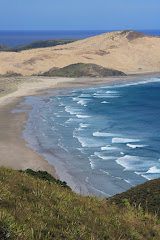
Hapuna Beach

Saturday, December 17, 2011

Borneo: Lankayan

For me to travel between Seoul and Lankayan, a small coral reef island in the Sulu Sea off the coast of Borneo--and, apparently, even closer to some islands belonging to the Philippines--required planes, trains, automobiles and a boat.  An international flight brought me to Kota Kinabalu, the capital city of the Sabah, one of two of Malaysia's states on the island of Borneo.  The next morning, with my "party," we flew to Sandakan.
My "party" at the entrance of the airport in Sandakan.

From the airport in Sandakan, we transferred to the Sandakan Yacht Club, where we boarded a speed boat for a rather rough--rainy season sea conditions--hour and a half ride to Lankayan Island Dive Resort.  With that ninety minute sea voyage, though, one transits into a world at the rim of primeval.


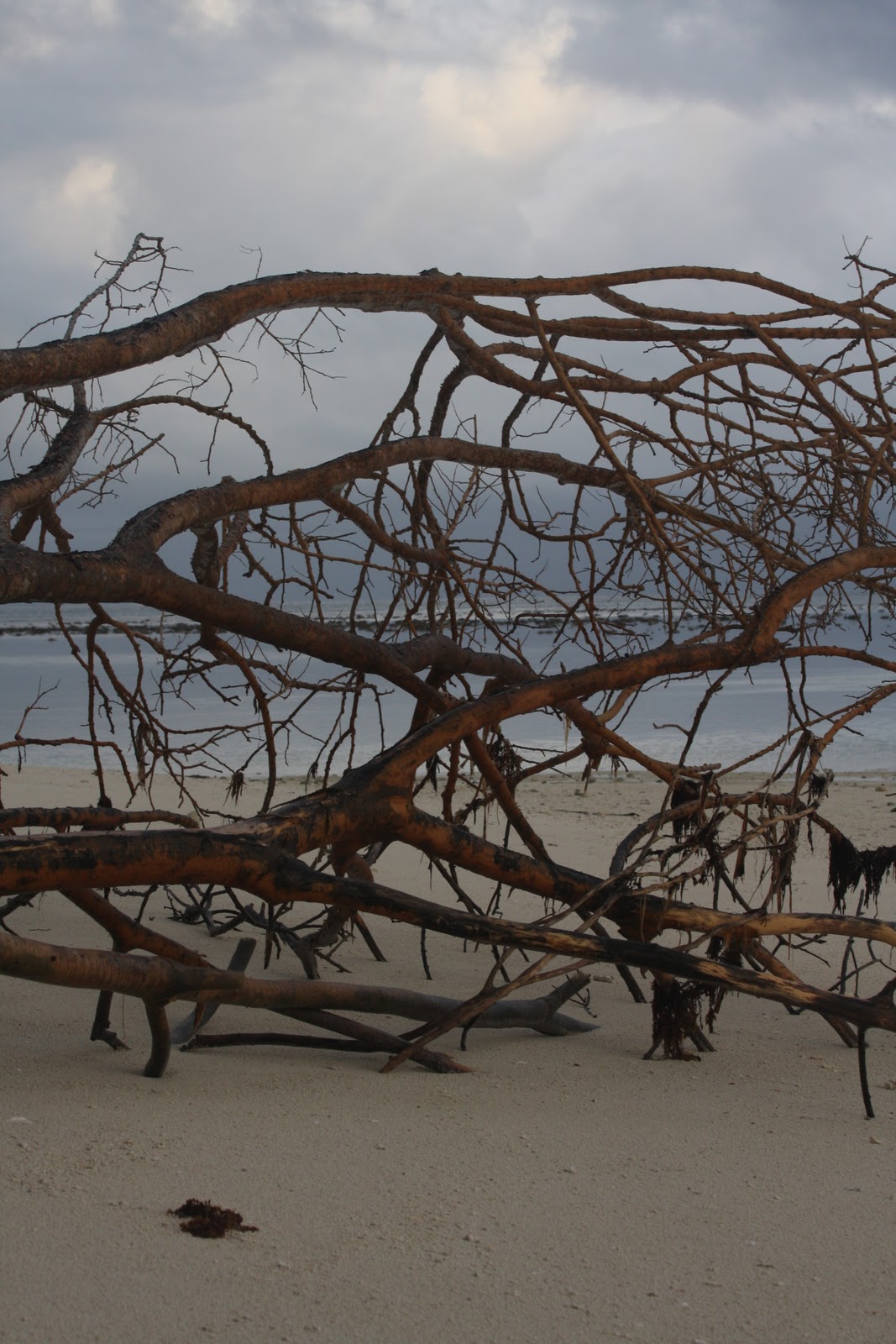
By foot, Lankayan can be circumnavigated in fifteen minutes, and the tide determines whether the entire walk transpires on sandy beach or with overs and unders of tropical undergrowth and the trunks of palms seemingly predisposed for horizontal positioning rather than vertical.  We walked that walk multiple times in a day, in rain and shine, at low tide and high tide and in between.


Everyday we did some lounging, fully embracing "island life." 
 Laura and I lived in this chalet.
 Our beach.
 The interior of our chalet.
A splendid panorama of a night sky to behold from this location, too!

The dining hall--verandas with a view...and WiFi (okay, not so primeval)!


We also snorkeled, and some dived; afterall, Lankayan is a dive resort of some renown. 
I am having a bit of trouble with one of my fins!
Yes, we snorkled with these, but they preferred not to be close to us!


We kayaked, too.
 Laura and I on our tour around the island via kayak.


And we caught two serendipitous moment.  Lankayan, situated in the sea turtle corridor and part of a marine protected area, is a nesting ground for sea turtles, both green and hawksbill.  One night we had the good fortune to witness a releasing of just-hatched sea turtles.


The second night we watched a turtle lay her eggs and then return to the sea.
After the turtles lay their eggs, they are collected and taken to a safer place in the center of the island until they hatch, at which time they are released to the sea.


Both experiences filled me with such reverential awe.  So immersed in the worlds that we humans labor both to construct and to live within, we are often oblvious to the beauty and the struggle encompassed in worlds adjacent, even connected, with our own.

Lankayan days filled in some of the empty spaces we forget we carry within us; they were magical.

Tuesday, December 13, 2011

Borneo: Padas River White Water Rafting

After my traveling buddies departed for Seoul late Saturday night, I had three days on my own in Borneo.  Once ensconced in a room with a sea view at the Hyatt in Kota Kinabalu, I managed fairly well  for the first two days.  By Tuesday, though, I was pretty much done with the single traveler thing and very much in remembrance of why I generally abstain from traveling on my own.  Without an all-day white water rafting trip booked for Monday, I might have remembered even sooner!  Happily for that Monday as well as for now, I have a happy white water rafting tale to report.

Of two offered rafting trips, I opted for the one on the Padas River rather than the Kiulu River for two reasons:  (1) rapids with a white water ranking of III and IV and (2) access to the river--located in the rainforested interior of the island--required a train ride on the oldest train (19th century) in Borneo.  Indeed, the train ride was as amazingly memorable as the rafting. 

After the collection of rafters from various Kota Kinabalu hotels, we headed by bus to Beaufort, about an hour and a half journey. 
Our train at the Beaufort Train Station.

In Beaufort we boarded the train--a local train, I should mention--and within 15-20 minutes, rainforest had extinguished any visible sign of a road; only a single railroad track, a river, and sporadic villages and jungle plantations emerged amid the lush vegetation. 


A paved road.
 A dirt road.
 No more roads.


Other than pauses at designated rail-side "train-stops" or an occasional "station" to allow for the movement of embarking and disembarking passengers, the train chugged its way through lands once occupied by the Murut, the last Borneo tribe to forsake the headhunter livestyle. 
"Train-stops"


At the Rayoh Station, the rafters alighted briefly to off-load goods and possessions not intended for the wet of raft travel while the train and the remaining passengers graciously waited.  (Scheduling, I'm sure, takes into account the significant contribution rafters make to the revenue generated by this train route.)  Once we had all reboarded, the train continued on its way.  At the Pangi Station, we exited again, this time to launch the rafts and commence our journey by water.

Once arrayed in helmets and life jackets and then briefly schooled in rafting skills and safety, we received our raft assignments.  One of two singles on the trip, I was placed with a group of four from Hong Kong.


They were super sweet to me, kind and accommodating!

Bryan, our raft's chief guide, immediately situated the two guys at the front--placement for the strongest paddlers--and then began the small talk banter that, in reality, provided him background information on our experience with rafts and rafting.  Come to find out, I was the only one, other than the guides, who had ever rafted before.  My USA status plus previous raft experience rather promptly sparked the question, "Have you rafted the Colorado?"  Well, I have, and I think the two guides were unduly impressed with my experience whereas my Hong Kong cohorts had no concept whatsoever of any significance "the Colorado" might impart.  Not too long after we were underway, both of the guides and I became acutely aware that our Hong Kong friends really didn't understand much about rafting and that commands given in English might or might not be acted upon.  Consequently, the guides played many of the rapids we ran more cautiously than some of the other rafts because their passenger-paddlers were not particularly effective!  At one point, Bryan even moved me to the front of the raft!  Still, it really was a grand time on the Padas River!

About and hour and a half later, just above the Rayoh Train Station, we pulled out of the river.  After showers and a change into dry clothes at Riverbug Rayoh Headquarters, we lunched on barbecued chicken with fixings and then chilled until train time.  As trite as the expression may be, I do believe that a good time was had by all!

 Rayoh Riverbug Headquarters and our lunch location.
 Some of the river guides' children hanging out at the lunch location.

 Collected rafting gear awaiting train transport.
Our train "home" approaches the Rayoh Station.

Sunday, December 11, 2011

Wild Man of Borneo

When I was a little girl, my mom talked about the “wild man from Borneo,” generally in reference to some family member’s hair and usually either hers or one of her three daughters.  She would state emphatically, “(I/You) look like the wild man from Borneo!” after which a good combing or brushing would ensue.  At first, I thought maybe Borneo might be in Africa, but Mom—ever geographically savvy—said, no, it was an island in Asia.  For a long time in my consciousness, though, Borneo continued to remain in a rather indeterminate location, somewhere in that nebulous blur of all those countries and islands situated in southern Asia.  Not until I moved to Asia did I truly sort out my own geographical visualization of the southern expanse of the largest continent, and, lo and behold, I rediscovered Borneo!  And then, I decided that someone in the family really ought to check out Mama’s “wild man”!   As I had the best proximity—currently residing on the same continent, no less—and the inclination, I did just that.  Over the Thanksgiving Break, I traveled to the island of Borneo.

Today the island of Borneo is divided among three countries:  Indonesia (73%), Malaysia (26%), and the entire sovereign state of Brunei (1%).  Home to one of the world’s oldest rainforests, Borneo also ranks as the third highest island in the world, thanks to Mt. Kinabalu (approximately 13,500 feet above sea level).   I visited Sabah, one of two of Malaysia’s states located on the island. 
 Mt. Kinabalu from the air.


Alas and alack, I now believe that Mama’s “wild man” has been tamed.  (Even so, I am impressed with such kind and gentle people as those I met Borneo.)  So here are the best options I have for the “wild man of Borneo.”

OPTION 1:           The “wildest” two I ever encountered I found while visiting a cultural village (think Oahu’s Polynesian Cultural Center on a much smaller scale), and mostly they’re young and really rather cute!

This one is "tweaking" darts to use with a blow gun!


OPTION 2:           People in Borneo refer to orangutans—considered among the most intelligent of primates—as the “wild men of Borneo.”  These days they only reside in the wild in the rainforests of Borneo and Sumatra.  I saw them at the Sepilok Orangutan Sanctuary near Sandakan. 
[Yes, I realize that at least the adult orangutan pictured is not technically a “wild MAN,” but, hey, a mama with baby fully inveigled my attention and, subsequently, my camera lens.]


Another statement my mama announced sporadically as we grew up—I suspect during those “last nerve” moments—was “I think I’ll run away to Timbuktu.”  Someday I would like to “run away” to Timbuktu, too, for just a little while, anyway . . .

Saturday, November 12, 2011

Fall Flings . . .

Views taken from walking paths in Namsan Park, heading to Seoul Tower.


with Gingkos (gingko biloba)

Because in Seoul's autumn they array themselves in lemony yellows and sunlit golds and their emancipated foliage looks like long-stemmed fans for slaves to cool lounging sultans in a miniaturized exotic realm, I learned the gingko tree.  Across pavement or path, the leaves pool like liquid saffron or else scatter like golden petals strewn before a bride.  I am entranced.
A gingko tree in my neighborhood.


with Sycamores

Their leaves are enormous.  One can completely cover my foot.  Early morning runs in November are largely accomplished in the dark, and on the more residential roads of my route, especially after wind or rain in the night, I can unexpectedly run across a carpeting of sycamore leaves and totally splash in the crunch.  It is a moment of full return to childhood and I always giggle aloud!
I wear a size seven and a half in a running shoe, so . . .


[Apparently the sycamores in Korea were imported from the USA because they make good roadside trees and are not easily affected by pollution.]

Looking up at the leaves on a sycamore in my neighborhood.